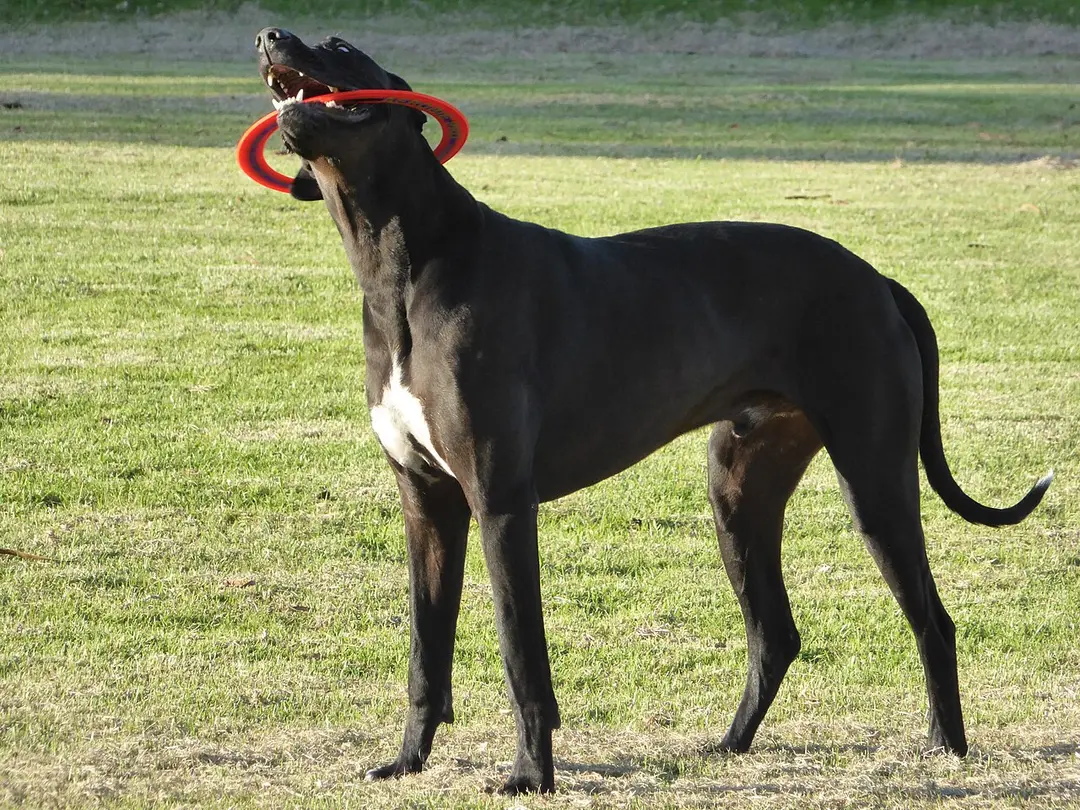
Great Dane

Patient and usually calm indoors, watchful with strangers.
Adult male
64–79 kg
140–175 lb
Adult female
50–64 kg
110–140 lb
Lifespan
10.6 yrs
Class · Companion
also Family, Watchdog

What it's like

In temperament the Great Dane is friendly, patient and dependable. It is affectionate with its household and usually calm indoors, but watchful with strangers. It is the state dog of Pennsylvania, and the cartoon dogs Scooby-Doo and Marmaduke are both Great Danes.

Owners in a large survey found Great Danes tend to be friendlier with other dogs than dogs in general. On independence, they were about average. Breed is only a small part of any one dog's personality, so meet the dog before you decide.
Day to day
Activity
Happy with modest walks
Intelligence
Easy-going, simple routines
Handler demand
Needs steady training
With people
Affection
A lap or leaning dog
Loyalty
Bonded to its family
Independence
Cooperative, with its own ideas
Around the home
Sensitivity
Average
Voice
Quiet
Prey drive
Chases; needs managing
Breed explains only about 9% of how individual dogs differ in behaviour1. Meet the dog. A good breeder breeds for temperament as well as health, and matches each puppy's personality to the right home2,3.
Is a Great Dane right for you?
Take the breed matcher

Living with one

It has a short coat. It sheds through the year rather than in big seasonal moults. Plan on a brush once a week. It needs a moderate amount of exercise compared with other breeds.

Size and growth

A Great Dane is a giant dog, heavier even than a Rottweiler. Males end up clearly heavier than females.

The modern Great Dane is tall and powerful but elegant, with a long, rectangular head, a deep chest and a square, level outline. Its coat is short, dense and glossy. Colours include fawn with a black mask, brindle, black, blue and harlequin, which is a white coat with ragged black patches. The ears were traditionally cropped to stand upright, and still are in some countries, but cropping is banned in the UK, where they fold forward and hang naturally.

Puppy growth

Reference curve · community data appears as owners log
By about 5 months, a male Great Dane puppy is already as heavy as a grown German Shepherd. They grow fastest between 4 and 5 months old. The chart follows Great Danes themselves, not a general size band. Most males grow into the size large-breed puppy foods are made for.
Fully grown
12 mo
Both sexes, at 99% of adult weight6
Male
Female
Shaded: expected range
0204060802m4m6m9m12m18m
0204060802m3m4m6m9m12m18m
Age
Male
Female
2 months
13.9–17.4 kg 30.6–38.4 lb
10.9–13.9 kg 24.0–30.6 lb
3 months
21.3–26.7 kg 47.0–58.9 lb
16.8–21.3 kg 37.0–47.0 lb
4 months
30.2–37.8 kg 66.6–83.3 lb
23.8–30.2 kg 52.5–66.6 lb
5 months
39.4–49.3 kg 86.9–108.7 lb
31.0–39.4 kg 68.3–86.9 lb
6 months
47.4–59.2 kg 104.5–130.5 lb
37.2–47.4 kg 82.0–104.5 lb
7 months
53.4–66.8 kg 117.7–147.3 lb
42.0–53.4 kg 92.6–117.7 lb
8 months
57.5–71.8 kg 126.8–158.3 lb
45.2–57.5 kg 99.6–126.8 lb
9 months
60.0–75.0 kg 132.3–165.3 lb
47.1–60.0 kg 103.8–132.3 lb
10 months
61.5–76.9 kg 135.6–169.5 lb
48.3–61.5 kg 106.5–135.6 lb
11 months
62.4–78.0 kg 137.6–172.0 lb
49.0–62.4 kg 108.0–137.6 lb
12 months
62.9–78.6 kg 138.7–173.3 lb
49.4–62.9 kg 108.9–138.7 lb
15 months
63.4–79.3 kg 139.8–174.8 lb
49.8–63.4 kg 109.8–139.8 lb

Health and lifespan

In UK vet and lab records, the conditions below turn up more often in Great Danes than in crossbreeds. Bone cancer, inward-rolling eyelid and outward-drooping eyelid stand out as far more likely. The most serious are bone cancer (far more likely) and mouth melanoma (much more likely), and both can shorten a life. These are figures for the breed as a whole, not a prediction for your dog.
Listed by likelihood level, highest first, then by how serious it is, then by name.
  • Bone cancer
    Far more likely
    Impact: life-limiting
  • Inward-rolling eyelid
    Far more likely
    Impact: moderate
  • Outward-drooping eyelid
    Far more likely
    Impact: minor
  • Mouth melanoma
    Lab-confirmed cases
    Much more likely
    Impact: life-limiting
  • Cherry eye
    Much more likely
    Impact: moderate
Lab-confirmed: compares dogs whose tumour samples went to a lab with dogs seen in general practice, so the figures run higher than vet-record ones.

Lifespan

In UK vet records, the typical Great Dane lived to about 10 and a half years, longer than the typical giant breed.

Where it comes from

The Great Dane is German: its forerunners were the bullenbeisser and the hunting and boar hounds, which went by many local names sorted by colour and size. In 1878 a committee of breeders and judges in Berlin merged them all as the Deutsche Dogge, and the first standard was set at a Berlin show in 1880. Why the French called it grand Danois is not known4,13.

The Great Dane was developed in Germany as a hunting dog of the nobility, used to catch and hold wild boar once hounds had run it down. As boar hunting declined, the breed was kept more for guarding and companionship. German courts kept favoured dogs as chamber dogs, which slept near their owners at night to protect them. Otto von Bismarck admired the breed and kept several.

Breed standard

The Great Dane is judged against standard no. 235, in group 2, Pinscher and Schnauzer, Molossoid and Swiss Mountain Dogs4.

Questions people ask

General guidance for dogs rather than a measured Great Dane figure: most females have a first season somewhere between six and fifteen months, and cycles then settle to roughly every 180 days. Smaller breeds tend to start earlier and larger ones later, so a giant breed is most likely at the late end.
Track your own Great Dane
Log a minute a day and watch them sit on these curves. Free.

Sources

Something wrong on this page?
Parts of this page were written by AI ·