Rottweiler
What it's like
By temperament the Rottweiler is calm, self-assured and watchful. It is devoted to its own household but reserved with strangers. The breed reached Britain in the nineteen-thirties and is now a familiar guard and companion dog there.
Living with one
Size and growth
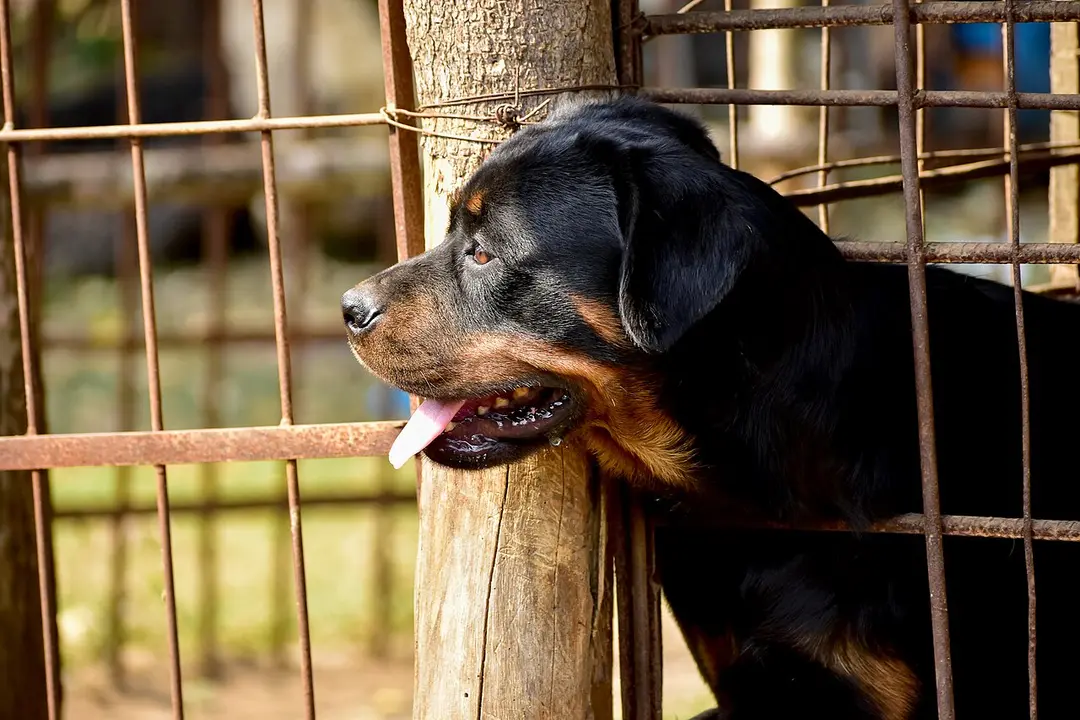
It is a powerful, compact dog with a broad head, a deep chest and a level back. Its coarse, straight outer coat lies flat over an undercoat on the neck and thighs. The standard coat is black, with clearly defined rich tan on the cheeks, muzzle, chest and legs and above each eye. Since tail docking was largely banned in Britain, most British Rottweilers have a natural tail.
Puppy growth
Health and lifespan
- Bone cancerFar more likelyImpact: life-limiting
- Elbow joint diseaseMuch more likelyImpact: serious
- Inward-rolling eyelidMuch more likelyImpact: moderate
- Blood-vessel cancerMore likelyImpact: life-limiting
- Lymph node cancerMore likelyImpact: life-limiting
Lifespan
Where it comes from
The Rottweiler's fortunes followed the cattle trade. In the nineteenth century, cattle droving declined, so the dog lost its work and nearly died out. It was remembered locally as the Rottweiler Metzgerhund, or butcher's dog. Enthusiasts revived it in the early twentieth century and formed breed clubs that later merged into a single German club. During the First World War it served the German army as a messenger and guard. The breed was developed to drive and control cattle and to guard people and goods. That work called for strength, stamina and a steady nerve.
Breed standard
Questions people ask
Compare with related
Sources
- 1Morrill et al., 2022. Ancestry-inclusive dog genomics challenges popular breed stereotypes. Science 376: eabk0639 (Darwin's Ark). ↑
- 2Dogs Trust. Finding a good, responsible breeder. ↑
- 3American Kennel Club. Screening puppy buyers: how top breeders find the best homes. ↑
- 4
- 5
- 6VetCompass UK. Primary-care veterinary records. ↑
- 7Hawthorne et al., 2004. Body-weight changes during growth in puppies of different breeds. Journal of Nutrition 134(8 Suppl): 2027S–2030S (WALTHAM). ↑
- 8AAFCO, 2016. AAFCO Dog and Cat Food Nutrient Profiles. Association of American Feed Control Officials. ↑
- 9
- 10
- 11
- 12
- 13
- 14
- 15
- 16The Kennel Club. Rottweiler. ↑