Saint Bernard
What it's like
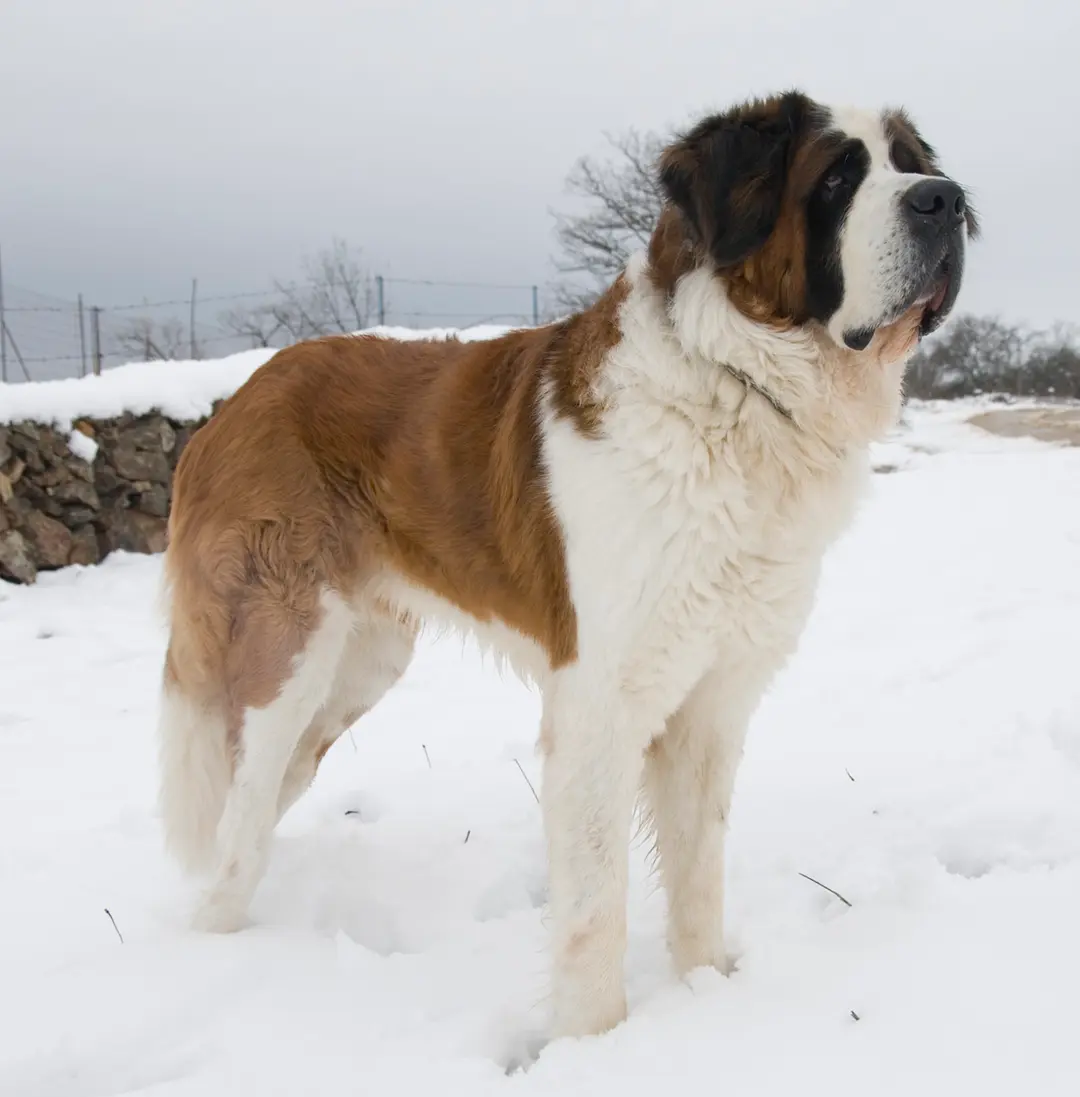
In temperament it is calm, gentle and good-natured, playful with its household and watchful towards strangers without being quick to aggression. The brandy cask often shown around its neck owes more to a painting by Edwin Landseer than to hospice practice.
Living with one
Size and growth
Bred to guard the hospice and find travellers in deep snow, it is a massive, powerfully built dog with a broad, heavy head, a short muzzle and a serious, kindly expression. The short coat is dense and close-lying; the long coat is straight to slightly wavy, with feathered legs and a bushy tail. Both are white with red patches or red with white, with white on the chest, feet and tail tip and darker shading around the eyes and ears.
Puppy growth
Health and lifespan
- Inward-rolling eyelidFar more likelyImpact: moderate
- Outward-drooping eyelidFar more likelyImpact: minor
- Blood blister in the ear flapMuch more likelyImpact: moderate
- Cherry eyeMuch more likelyImpact: moderate
- Lymph node cancerMore likelyImpact: life-limiting
Lifespan
Where it comes from
The Saint Bernard took its present name only in the nineteenth century; before that the hospice dogs went by several names, including Barry dogs, after a famous rescuer whose preserved body is displayed in the Natural History Museum in Bern. In the first half of that century the monks crossed their dogs with Newfoundlands, which is usually credited with introducing a long coat. Ice reportedly clung to the longer hair, so long-coated puppies were given away, and the breed spread among lowland breeders.
Breed standard
Questions people ask
Compare with related
Sources
- 1Morrill et al., 2022. Ancestry-inclusive dog genomics challenges popular breed stereotypes. Science 376: eabk0639 (Darwin's Ark). ↑
- 2Dogs Trust. Finding a good, responsible breeder. ↑
- 3American Kennel Club. Screening puppy buyers: how top breeders find the best homes. ↑
- 4
- 5American Kennel Club. Saint Bernard breed page. ↑
- 6Hawthorne et al., 2004. Body-weight changes during growth in puppies of different breeds. Journal of Nutrition 134(8 Suppl): 2027S–2030S (WALTHAM). ↑
- 7AAFCO, 2016. AAFCO Dog and Cat Food Nutrient Profiles. Association of American Feed Control Officials. ↑
- 8
- 9
- 10
- 11
- 12