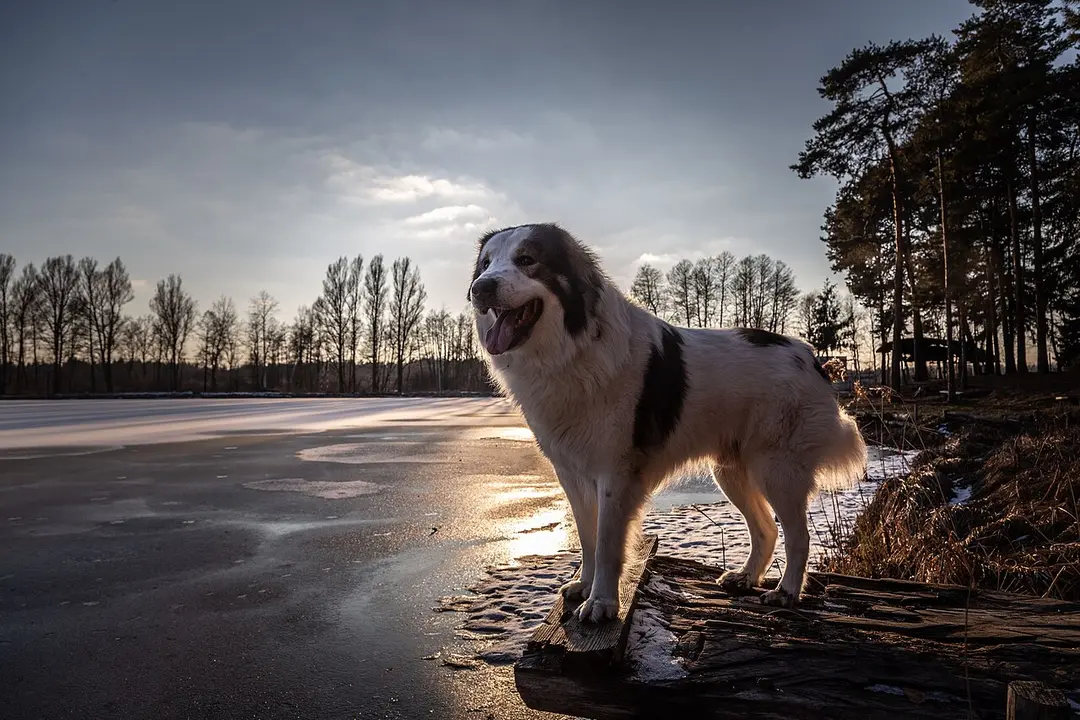
Tornjak

Calm and good-natured at home, a determined guard.
Adult male
35–50 kg
77–110 lb
Adult female
28–40 kg
62–88 lb
Lifespan
12–14 yrs
Class · Watchdog
also Working

What it's like

The Tornjak is calm and steady, devoted to its family and dignified in manner. It is good-natured with people it knows but alert and wary of strangers, and it guards its territory with determination. Bred to be hardy, it traditionally lived and slept outdoors beside its flock, even in mountain snow.

Day to day
Activity
A good daily walk and play
Intelligence
Learns readily, likes games
Handler demand
Needs an experienced owner
With people
Affection
Likes its own space
Loyalty
Sticks close to its people
Independence
Decides for itself
Around the home
Sensitivity
Hardy, takes a busy home in its stride
Voice
Barks to alert, then settles
Prey drive
Usually fine with small pets
Breed explains only about 9% of how individual dogs differ in behaviour1. Meet the dog. A good breeder breeds for temperament as well as health, and matches each puppy's personality to the right home2,3.
Is a Tornjak right for you?
Take the breed matcher

Living with one

It has a long coat. Most of the shedding comes when the seasons change. Plan on daily brushing. It needs a moderate amount of exercise compared with other breeds.

Size and growth

A Tornjak is a large dog, about the weight of a grown German Shepherd. Males end up clearly heavier than females.

It is a large, powerful dog with a body close to square and solid bone. The long, thick coat has a dense woolly undercoat and is usually white with patches of darker colour. The long, heavily feathered tail is carried high when the dog moves and is often likened to a waving flag.

Puppy growth

Reference curve · community data appears as owners log
Tornjaks reach half their adult weight at about 5 months. They grow fastest between 4 and 5 months old. They keep growing past their first birthday, longer than a Beagle does. Most males grow into the size large-breed puppy foods are made for.
Fully grown
13 mo
Both sexes, at 99% of adult weight6
Male
Female
Shaded: expected range
02040602m4m6m9m12m18m
02040602m3m4m6m9m12m18m
Age
Male
Female
2 months
6.1–8.7 kg 13.4–19.2 lb
6.4–9.2 kg 14.1–20.3 lb
3 months
9.8–14.0 kg 21.6–30.9 lb
9.3–13.3 kg 20.5–29.3 lb
4 months
14.5–20.8 kg 32.0–45.9 lb
13.5–19.3 kg 29.8–42.5 lb
5 months
19.7–28.1 kg 43.4–61.9 lb
17.2–24.5 kg 37.9–54.0 lb
6 months
24.4–34.9 kg 53.8–76.9 lb
20.2–28.8 kg 44.5–63.5 lb
7 months
28.1–40.2 kg 61.9–88.6 lb
22.4–32.0 kg 49.4–70.5 lb
8 months
30.7–43.9 kg 67.7–96.8 lb
23.9–34.2 kg 52.7–75.4 lb
9 months
32.4–46.3 kg 71.4–102.1 lb
25.1–35.8 kg 55.3–78.9 lb
10 months
33.5–47.8 kg 73.9–105.4 lb
25.8–36.9 kg 56.9–81.4 lb
11 months
34.1–48.7 kg 75.2–107.4 lb
26.4–37.7 kg 58.2–83.1 lb
12 months
34.5–49.3 kg 76.1–108.7 lb
26.8–38.3 kg 59.1–84.4 lb
15 months
34.9–49.8 kg 76.9–109.8 lb
27.6–39.4 kg 60.8–86.9 lb

Lifespan

No vet study has measured how long Tornjaks live yet. The 12–14 years shown is a general figure without a published source.

Where it comes from

The Tornjak is a herding dog, livestock guardian and farmyard guard of the mountains and valleys of Bosnia and Herzegovina and Croatia. Its FCI standard cites written documents from 1067 and 1374 as the first to mention it. The breed was re-created from nearly extinct descendants of the region's old native shepherd dogs, in a rescue begun in both countries around 1972, with continuous pure breeding from 19784.

The Tornjak takes its name from tor, the local word for a pen in which sheep are kept, reflecting its long association with the flocks of the Dinaric mountains. After the late twentieth-century revival, breeders worked to fix a consistent type, and the breed was later accepted by the Fédération Cynologique Internationale, which names Bosnia and Herzegovina and Croatia jointly as its homeland. Its work was to guard sheep and other livestock against wolves, bears and thieves, often travelling with flocks between winter valleys and summer mountain pastures, and to keep watch over farmyards.

Breed standard

The Tornjak is judged against standard no. 355, in group 2, Pinscher and Schnauzer, Molossoid and Swiss Mountain Dogs4.

Questions people ask

General guidance for dogs rather than a measured Tornjak figure: most females have a first season somewhere between six and fifteen months, and cycles then settle to roughly every 180 days. Smaller breeds tend to start earlier and larger ones later, so a large breed is most likely at the later end.
Track your own Tornjak
Log a minute a day and watch them sit on these curves. Free.

Sources

Uncited on this page: Lifespan — no reviewed source yet, so it is a general reference figure rather than a published one.
Something wrong on this page?
Parts of this page were written by AI ·