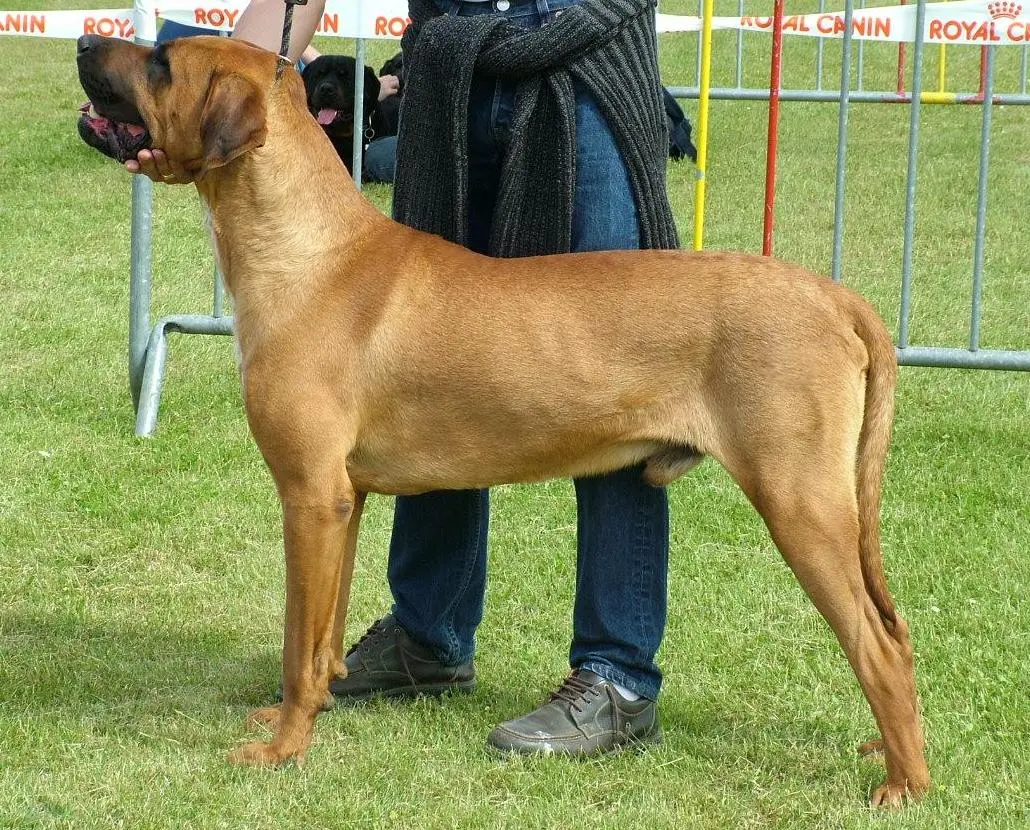
Tosa

Quiet, patient and steady; brave rather than excitable.
Adult male
45–90 kg
99–198 lb
Adult female
40–70 kg
88–154 lb
Lifespan
10–12 yrs
Class · Watchdog

What it's like

The Tosa is a large, powerful dog with a broad skull, a square muzzle, small hanging ears and a noticeable dewlap of loose skin at the throat. Its short, hard, dense coat is most often red or fawn, though apricot, black and brindle also occur, sometimes with small white marks on the chest and feet. In temperament it is quiet, patient and steady, reserved with strangers, and brave rather than excitable.

Day to day
Activity
A good daily walk and play
Intelligence
Easy-going, simple routines
Handler demand
Needs an experienced owner
With people
Affection
Likes its own space
Loyalty
Sticks close to its people
Independence
Decides for itself
Around the home
Sensitivity
Hardy, takes a busy home in its stride
Voice
Quiet
Prey drive
Chases; needs managing
Breed explains only about 9% of how individual dogs differ in behaviour1. Meet the dog. A good breeder breeds for temperament as well as health, and matches each puppy's personality to the right home2,3.
Is a Tosa right for you?
Take the breed matcher

Living with one

It has a short coat. It sheds through the year rather than in big seasonal moults. Plan on a brush once a week. It needs a moderate amount of exercise compared with other breeds.

Size and growth

A Tosa is a large dog, about the weight of a grown Great Dane. Males end up clearly heavier than females. It is one of the heaviest large breeds.

Puppy growth

Reference curve · community data appears as owners log
By about 5 months, a male Tosa puppy is already as heavy as a grown German Shepherd. They grow fastest between 4 and 5 months old. They keep growing past their first birthday, longer than a Beagle does. Most males grow into the size large-breed puppy foods are made for.
Fully grown
13 mo
Both sexes, at 99% of adult weight6
Male
Female
Shaded: expected range
02550751002m4m6m9m12m18m
02550751002m3m4m6m9m12m18m
Age
Male
Female
2 months
7.8–15.7 kg 17.2–34.6 lb
7.0–12.2 kg 15.4–26.9 lb
3 months
12.6–25.2 kg 27.8–55.6 lb
11.2–19.6 kg 24.7–43.2 lb
4 months
18.7–37.4 kg 41.2–82.5 lb
16.6–29.0 kg 36.6–63.9 lb
5 months
25.3–50.7 kg 55.8–111.8 lb
22.5–39.4 kg 49.6–86.9 lb
6 months
31.4–62.8 kg 69.2–138.5 lb
27.9–48.9 kg 61.5–107.8 lb
7 months
36.2–72.4 kg 79.8–159.6 lb
32.2–56.3 kg 71.0–124.1 lb
8 months
39.5–79.0 kg 87.1–174.2 lb
35.1–61.5 kg 77.4–135.6 lb
9 months
41.7–83.3 kg 91.9–183.6 lb
37.0–64.8 kg 81.6–142.9 lb
10 months
43.0–86.0 kg 94.8–189.6 lb
38.2–66.9 kg 84.2–147.5 lb
11 months
43.8–87.7 kg 96.6–193.3 lb
39.0–68.2 kg 86.0–150.4 lb
12 months
44.3–88.7 kg 97.7–195.5 lb
39.4–69.0 kg 86.9–152.1 lb
15 months
44.8–89.7 kg 98.8–197.8 lb
39.9–69.8 kg 88.0–153.9 lb
18 months
45.0–89.9 kg 99.2–198.2 lb
40.0–69.9 kg 88.2–154.1 lb

Lifespan

No vet study has measured how long Tosas live yet. The 10–12 years shown is a general figure without a published source.

Where it comes from

The Tosa was produced for Japan's dog-fighting tradition, dating to the 14th century, by crossing the Shikoku-ken with Western breeds, among them Bulldogs from 1872, Mastiffs, German Pointers and Great Danes. It takes its name from the Tosa district, and some know it as the Japanese Mastiff. In the UK, it's against the law to own certain types of dog, and the Japanese Tosa is one of them4,8.

The Tosa took shape in what is now Kochi Prefecture on the island of Shikoku, where breeders in the late nineteenth and early twentieth centuries turned crosses between native dogs and several imported Western breeds into a consistent type. Its numbers fell sharply during the Second World War. Afterwards the breed was rebuilt from surviving dogs, some of them kept elsewhere in Japan, and Kochi is still closely associated with it. The Tosa was bred to fight under rules modelled on sumo wrestling. Traditionally, a dog that barked, growled or whined during a bout was counted as the loser, so breeders favoured silent, composed animals. Champions have been given ranks borrowed from sumo and paraded in decorated aprons and ceremonial ropes, much like the wrestlers themselves.

Breed standard

The Tosa is judged against standard no. 260, in group 2, Pinscher and Schnauzer, Molossoid and Swiss Mountain Dogs4.

Questions people ask

General guidance for dogs rather than a measured Tosa figure: most females have a first season somewhere between six and fifteen months, and cycles then settle to roughly every 180 days. Smaller breeds tend to start earlier and larger ones later, so a large breed is most likely at the later end.
Track your own Tosa
Log a minute a day and watch them sit on these curves. Free.

Sources

Uncited on this page: Lifespan — no reviewed source yet, so it is a general reference figure rather than a published one.
Something wrong on this page?
Parts of this page were written by AI ·