Xoloitzcuintli (Intermediate)
What it's like
The intermediate falls between the other two sizes and keeps the outline of the larger dog in a more compact frame. It is calm and quiet at home and closely attached to its family. It is reserved with strangers and alert, though not usually a heavy barker.
Living with one
Size and growth
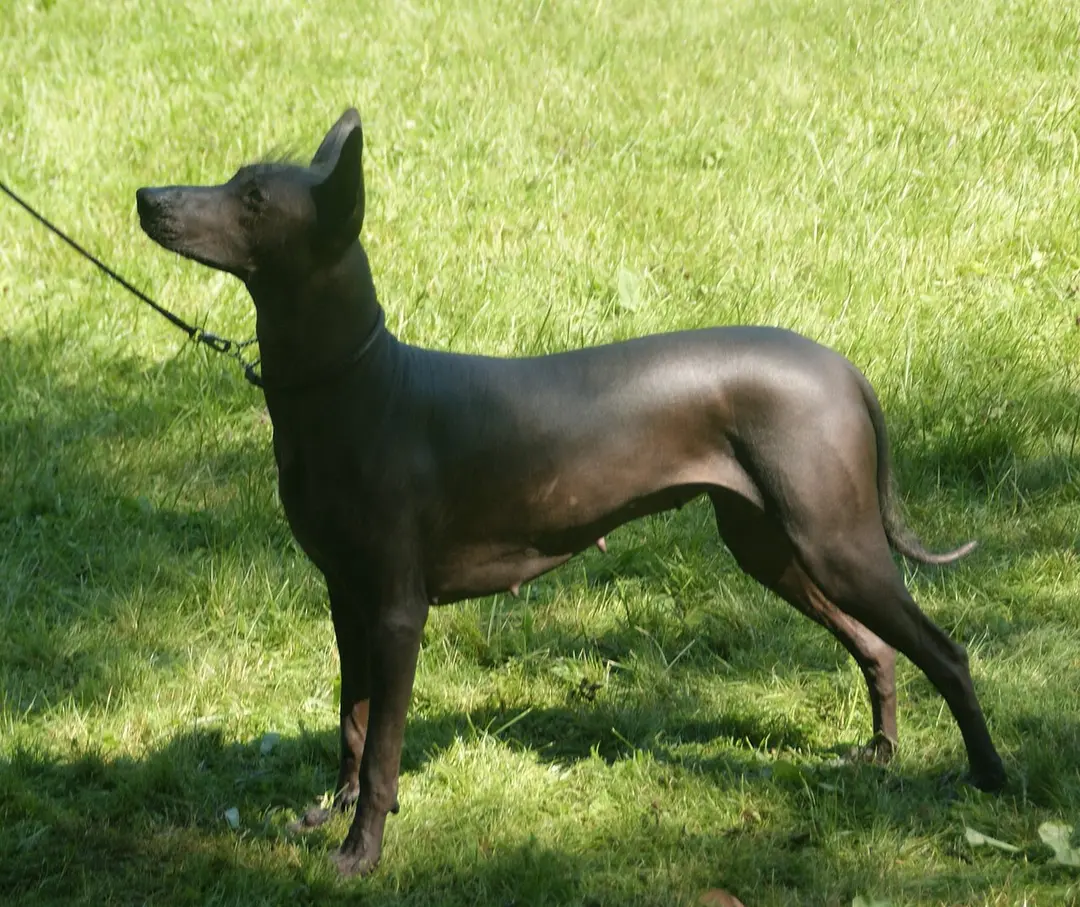
The breed is lean and graceful, with a wedge-shaped head and large upright ears often compared to a bat's. Most are hairless, with smooth, close skin in dark shades such as black, slate or bronze, sometimes with a few short hairs on the head or tail. Hairless dogs carry a single copy of a dominant gene, so puppies with a short, flat coat turn up in litters.
Puppy growth
Lifespan
Where it comes from
The Intermediate Xoloitzcuintli is one size of an ancient hairless dog of the Americas, kept in Mexico long before the Spanish arrived. Its name joins Xolotl, an Aztec god, with the Nahuatl word for dog, and clay dog figures from ancient tombs in western Mexico are often linked to it. Early peoples kept these dogs as companions and used them for food and ritual. By the mid twentieth century the breed had grown scarce. Enthusiasts gathered dogs from remote villages to rebuild it, and it gained formal recognition in Mexico during the nineteen-fifties.
Breed standard
Questions people ask
Compare with related
Sources
- 1Morrill et al., 2022. Ancestry-inclusive dog genomics challenges popular breed stereotypes. Science 376: eabk0639 (Darwin's Ark). ↑
- 2Dogs Trust. Finding a good, responsible breeder. ↑
- 3American Kennel Club. Screening puppy buyers: how top breeders find the best homes. ↑
- 4
- 5
- 6Hawthorne et al., 2004. Body-weight changes during growth in puppies of different breeds. Journal of Nutrition 134(8 Suppl): 2027S–2030S (WALTHAM). ↑
- 7Xoloitzcuintli Club of America. About Xolos. ↑
- 8American Kennel Club. Xoloitzcuintli breed standard. ↑