Xoloitzcuintli
What it's like
The Xolo is calm, alert and loyal. It forms close bonds with its family and is reserved with strangers, which makes it a watchful guard. Hairless and coated puppies can be born in the same litter.
Living with one
Size and growth
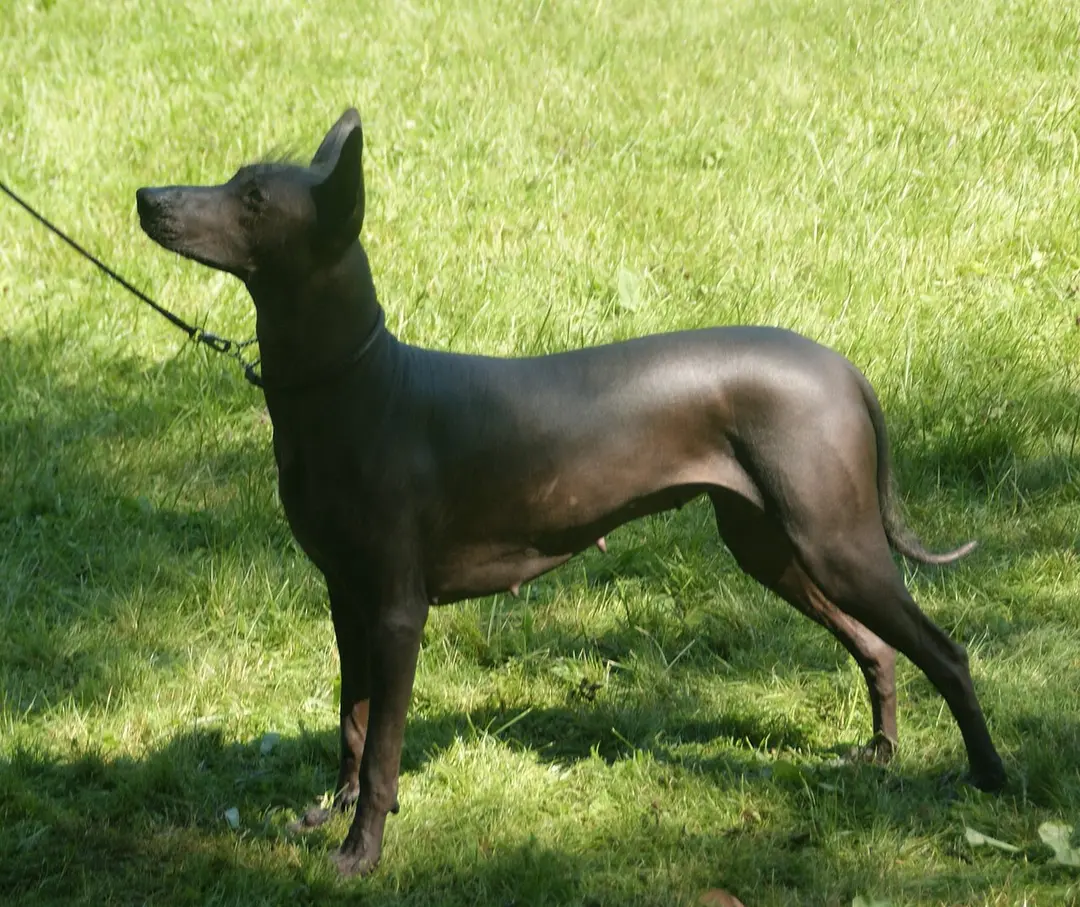
It is lean and slightly longer than tall, with a wedge-shaped head, large upright ears and almond-shaped eyes. The hairless variety has smooth, tough skin, usually in dark shades such as black, slate or bronze, sometimes with spots, and may have short hair on the head, feet or tail. Coated dogs have a short, flat coat.
Varieties
Puppy growth
Lifespan
Where it comes from
The Xoloitzcuintli, usually shortened to Xolo, survives in its modern form largely because of work done in the mid-twentieth century. By then purebred hairless dogs had become scarce, and in the mid-nineteen-fifties the British-born naturalist Norman Pelham Wright joined a Mexican Kennel Club search of remote villages for dogs to found a breeding programme. Official recognition in Mexico followed soon after. The painters Frida Kahlo and Diego Rivera had already kept Xolos and put them in their work, which helped raise the breed's profile. In pre-Hispanic Mexico the Xolo was linked to the god Xolotl and to burial practices. Folk tradition also valued the warmth of its bare skin.
Breed standard
Questions people ask
Compare with related
Sources
- 1Morrill et al., 2022. Ancestry-inclusive dog genomics challenges popular breed stereotypes. Science 376: eabk0639 (Darwin's Ark). ↑
- 2Dogs Trust. Finding a good, responsible breeder. ↑
- 3American Kennel Club. Screening puppy buyers: how top breeders find the best homes. ↑
- 4
- 5American Kennel Club. Xoloitzcuintli breed page. ↑
- 6
- 7Hawthorne et al., 2004. Body-weight changes during growth in puppies of different breeds. Journal of Nutrition 134(8 Suppl): 2027S–2030S (WALTHAM). ↑
- 8American Kennel Club. Xoloitzcuintli breed standard. ↑